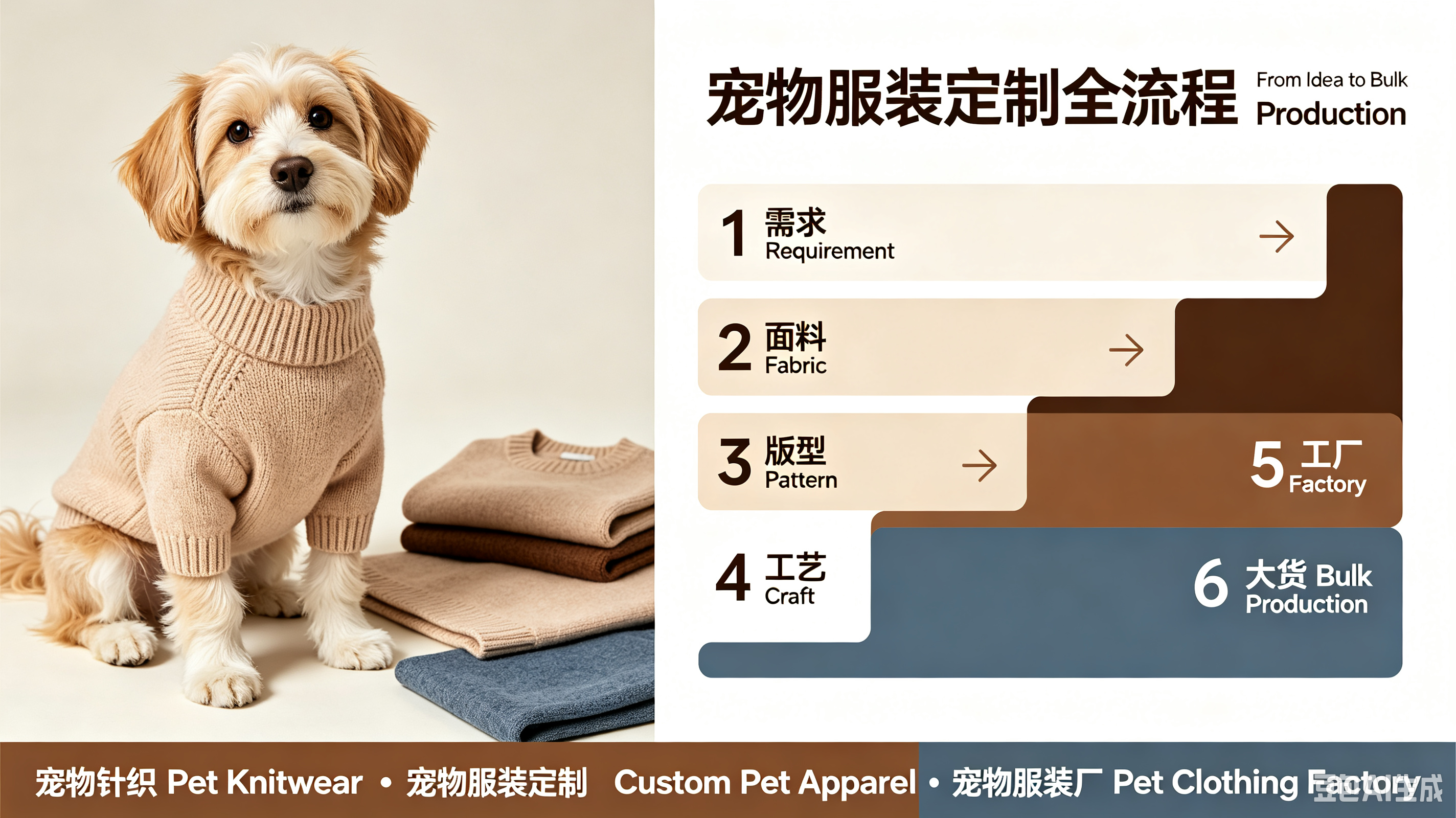
End-to-End Guide to Custom Pet Apparel: From Requirements to Factory Selection
Complete Guide to Custom Pet Apparel: From Needs Assessment to Factory Selection As the pet apparel industry evolves toward higher quality and brand development, demand for custom pet clothing has surged. For emerging pet brands and boutique retailers, understanding the customization workflow, fabric selection criteria, pattern development essentials, and factory screening logic is critical before entering this space. This article outlines the entire custom pet apparel process from a production perspective, highlighting key considerations for core categories like knitted pet wear.
Full Process Analysis of Custom Pet Apparel: From Requirement Triage to Factory Selection As the pet apparel industry shifts toward quality and branding, demand for custom pet clothing has surged. For new pet brands and premium retail outlets, understanding the end-to-end process—from fabric selection standards and pattern development nuances to factory screening logic—is essential before entering the market. This article objectively outlines the complete workflow for custom pet apparel, grounded in production realities and the unique characteristics of core categories like pet knitwear.
1. Pre-Order Requirements Review Before starting the custom pet apparel process, clarify three foundational elements: Style positioning: Options include minimalist Korean style, Instagram minimalism, luxury holiday designs, or outdoor functional wear. Each style directly dictates fabric selection and silhouette development, as well as the focus on knitted versus woven categories. Price point strategy: Premium mid-to-high-end lines differ fundamentally from mass-market affordable routes in yarn grade, craftsmanship standards, and trim specifications. Order volume projection: Small-batch sampling for initial testing requires different production scheduling and pricing structures compared to medium-to-large-scale restocking orders.
Pre-qualify Demand Requirements Before starting custom pet apparel production, three key factors must be defined: 1. Style Positioning: Choose from minimalist Korean, Instagram minimalism, luxury holiday, or outdoor functional styles. Your choice determines fabric selection, pattern development, and whether to focus on knitwear or woven categories. 2. Price Range: Premium mid-to-high-end and low-cost mass-market routes differ significantly in yarn quality, craftsmanship standards, and accessory specifications. 3. Order Volume Estimation: Small batches for initial trial styles and medium-to-large batches for restocking require different production scheduling and pricing structures.
2. Technical Guidelines for Fabric Selection The core distinction between custom pet apparel and mass-produced items lies in fabric controllability. Current fabric options include: knitwear using core-spun yarns, high-elasticity filaments, or cotton blends; woven fabrics utilizing polyester-cotton blends or functional waterproof materials; and heavyweight winter styles employing fleece or composite fabrics. During the selection phase, request hand-feel samples, as swatches often differ from finished garments in drape, stretch, and thickness. Additionally, obtain shrinkage rates, colorfastness ratings, and pilling resistance data during the sampling stage. Functional fabrics must be validated through physical testing.
Fabric Selection: Key Technical Considerations The core distinction between custom pet apparel and off-the-shelf products is fabric control. Current fabric options for pet clothing include: knitwear using core-spun yarns, high-stretch filaments, or cotton blends; woven styles featuring polyester-cotton blends or functional waterproof materials; and autumn/winter heavy-duty garments made from fleece or composite fabrics. Request hand-feel swatches during material selection to account for differences in drape, elasticity, and thickness between samples and finished garments. Obtain test data on shrinkage, color fastness, and pilling resistance at the sampling stage, and verify all functional fabrics through actual performance testing.
3. Industry Specifics of Pattern Development Pet apparel patterns must be developed independently and cannot be simply scaled from human clothing structures. This is especially critical for knitted pet wear, where elasticity requires precise control. Due to significant size variations across breeds, professional pet garment manufacturers maintain dedicated pattern databases covering cats and multiple dog breeds. During development, three key parameters require close monitoring: chest ease to ensure adequate range of motion, neckline elasticity to balance ease of dressing with a secure fit, and abdominal curvature to prevent fabric bunching and ensure smooth wear. The prototyping cycle typically takes 3–5 working days, followed by 1–2 rounds of minor adjustments before final confirmation.
Pet apparel patterns require independent development and cannot be scaled proportionally from human clothing designs. Stretch patterns for knitwear, in particular, demand precise control. Given the significant size variations across breeds, professional pet clothing manufacturers must maintain a pattern library covering cats and multiple dog breeds. During development, three key parameters are monitored: chest ease to allow movement, neckline stretch to balance wearability and fit, and abdominal curvature to prevent fabric bunching. The sampling cycle typically spans 3–5 working days, with 1–2 rounds of fine-tuning required after the initial version is completed.
4. Materials and Craft Standards Differentiation in mid-to-high-end custom pet apparel lies in its materials and craftsmanship. Logos are primarily rendered via precision embroidery, though this requires a minimum base fabric thickness. Processes like rhinestone or foil heat transfer must undergo rigorous washability testing. For knitted pet garments, ribbed cuffs should be densely reinforced; resin buttons and nylon zippers are recommended to avoid the weight of metal components and cold-skin discomfort. Inner seams of close-fitting styles must feature flat-felled or bound finishes to eliminate raw edges.
Accessory and Craftsmanship Standards Differentiation in mid-to-high-end custom pet apparel is defined by accessories and construction quality. - **Embroidery**: Ideal for LOGO display, but requires sufficient base fabric thickness. - **Decorative Details**: Hot-fix rhinestones and silver stamping must pass rigorous wash-resistance testing. - **Knitwear Finishes**: Ribbed edges demand tight, dense stitching to prevent deformation. - **Fasteners & Zippers**: Use resin buttons and nylon zippers to reduce weight and avoid cold metal contact with pets. - **Seam Construction**: Close-fitting styles require flatlock stitching or bound seams to eliminate raw edge exposure.
5. Factory Selection Criteria The current pet apparel customization landscape in China includes three main types: dedicated pet clothing manufacturers, human apparel factories that have added pet production lines, and individual tailoring workshops. Dedicated pet apparel factories offer extensive pattern-making expertise and flexible minimum order quantities (MOQs), with established capacity for categories like pet knits. Human apparel factories transitioning to pet lines bring mature craftsmanship but may require time to adapt to pet body shapes. Small workshops provide quick prototyping but often lack consistency in bulk production. When evaluating potential partners, prioritize factories that first clarify your style direction and order volume before proposing solutions, and those willing to send fabric swatches or sample garments for tactile verification—these are strong indicators of true pet apparel customization capability. For small-batch premium customization, MOQs typically start at just a few dozen units.
Factory Screening: Key Reference Dimensions The custom pet apparel industry relies on three primary channels: specialized pet clothing manufacturers, human apparel lines converted for pets, and independent tailor workshops. Specialized pet factories offer extensive pattern expertise, flexible minimum order quantities (MOQs), and mature production capabilities for categories like knitwear. Converted human apparel lines bring established craftsmanship but require experience adapting to pet body types. Small workshops provide rapid sampling, though batch consistency may be inconsistent. When evaluating suppliers, verify if they clarify style direction and volume before proposing solutions, and whether they are willing to send fabric swatches—these are critical indicators of their custom service capability. For small-batch premium customization, MOQs typically start at dozens of units.
6. Process Timeline Management The custom pet apparel workflow includes requirement discussion, sampling, revision confirmation, bulk production, and quality inspection. Sampling typically takes 3–5 business days; bulk production requires 7–15 days. Complex designs or peak seasons may extend these timelines. Thorough initial communication and meticulous sample approval are essential for ensuring consistent bulk order quality.
Process Cycle Management The custom pet apparel workflow spans demand communication, sampling, revision approval, bulk production, and quality inspection. Sampling takes approximately 3–5 business days; bulk production requires about 7–15 days, which may extend for complex styles or peak seasons. Clear early communication and thorough sample approval are essential to ensure consistent bulk quality.
Dongguan Kaiyingmei Garment is a professional pet apparel manufacturer specializing in mid-to-high-end knitted and custom pet clothing. We operate an independent design team, a comprehensive pattern library, and a complete production line. Our core services include original design development, sample making from provided images, private label customization, and small-batch premium production. We focus exclusively on wholesale for mid-to-high-end markets, providing design prototyping and bulk supply to boutique pet stores, original pet brands, and high-quality cross-border orders. We do not engage in retail sales.
Dongguan Kaiyingmei Apparel is a professional pet clothing manufacturer specializing in mid-to-high-end knitwear and custom apparel. We feature an in-house design team, a comprehensive pattern library, and fully integrated production lines. Our core services include original design development, pattern creation from reference images, private label customization, and small-batch premium orders. We operate exclusively on a wholesale model for mid-to-high-end markets. We provide design sampling and bulk supply solutions for premium pet boutiques, original pet brands, and high-quality cross-border clients. We do not engage in retail sales.