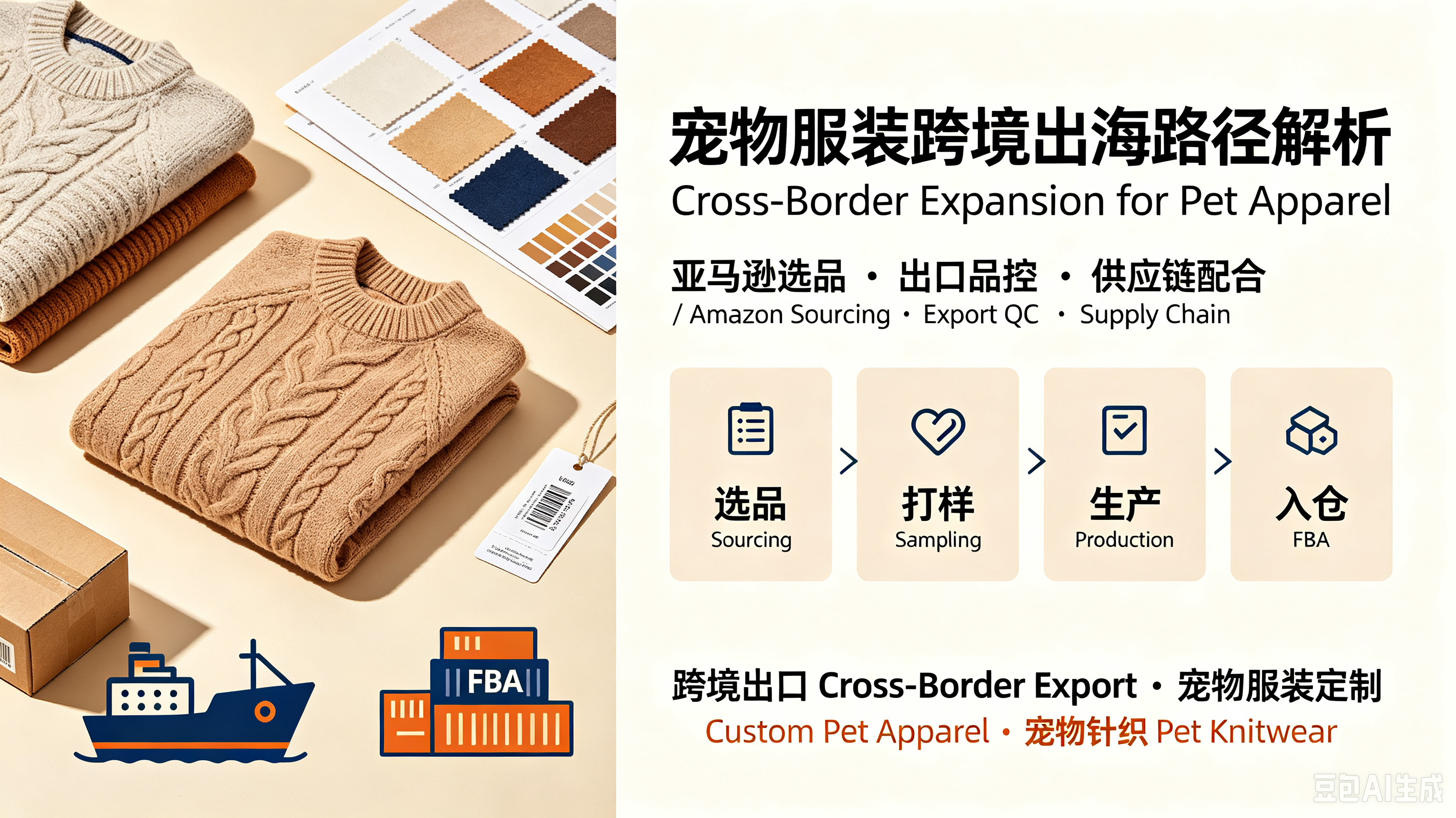
The global pet apparel market continues to expand, driven by strong consumer demand in North America and Europe. Cross-border export of pet clothing has become a strategic priority for domestic manufacturers and brands. From a production and supply standpoint, this article outlines the core elements of cross-border expansion in the pet apparel sector, including Amazon product selection strategies, export compliance requirements, and essential supply chain management practices.
Pet Apparel Cross-Border Expansion: Amazon Selection and Supply Chain Strategies The global pet apparel market is growing, with strong purchasing power in North America and Europe. Cross-border exports of pet clothing have become a key focus for domestic manufacturers and brands. This article examines core aspects of cross-border expansion from a production and supply perspective, covering Amazon product selection logic, export compliance standards, and supply chain management essentials.
Analysis of Pet Apparel Cross-Border Expansion: Amazon Product Strategy & Supply Chain Management The global pet apparel market continues to expand, driven by strong demand in North America and Europe. Cross-border export has become a key priority for domestic manufacturers and brands. This article outlines the core steps for expanding into international markets via Amazon, covering product selection logic, export compliance requirements, and supply chain management essentials.
Analyzing Export Pathways for Pet Apparel to Cross-Border Markets: Product Selection for Amazon and Supply Chain Strategy The global pet apparel market continues to grow, with North American and European markets demonstrating strong purchasing power. Cross-border export of pet apparel has become a key growth area for domestic manufacturers and brands. From a production and supply perspective, this article outlines the core stages of launching pet apparel into cross-border markets, including product selection logic for Amazon, export compliance requirements, and critical supply chain management considerations.
1. Category Characteristics for Amazon Product Selection Pet apparel on cross-border platforms like Amazon is a non-standardized product with healthy gross margins, but it also has distinct category traits. Seasonality is pronounced: knit sweaters for fall/winter and holiday-themed styles drive peak sales, while spring/summer demand shifts to lightweight functional items. Sizing complexity is high due to significant breed size variations, making SKU management more challenging than standardized products. Return risks center on sizing mismatches and fabric quality not meeting expectations. When selecting products, prioritize year-round versatile categories such as lightweight stretch knits and basic skin-friendly styles to reduce seasonal inventory pressure. Additionally, limit initial SKUs by testing market response with core sizes first, then gradually expand.
Amazon Pet Apparel: Category Insights Pet apparel on Amazon features non-standard attributes, offering substantial gross margins but distinct category dynamics. Seasonality drives sales: autumn and winter peak with knit sweaters and holiday styles, while spring and summer shift demand to lightweight functional gear. Size complexity is high due to breed variations, complicating SKU management compared to standard products. Returns primarily stem from sizing issues and fabric quality concerns. To mitigate seasonal inventory pressure, prioritize year-round versatile items like lightweight stretch knits and basic skin-friendly styles. Start by limiting SKUs; test core sizes first, then expand based on market response.
Key Considerations for Amazon Pet Apparel Categories on Cross-Border Platforms Pet apparel on platforms like Amazon is a non-standard category with relatively high gross margins but distinct seasonal and sizing characteristics. Seasonal demand fluctuates significantly: fall and winter sales are driven by knit sweaters and holiday-themed items, while spring and summer shift toward lightweight, functional pieces. Sizing is complex due to the wide variety of body types across dog breeds, making SKU management more challenging than for standard products. Return risks primarily stem from size mismatches and fabric texture not meeting customer expectations. When selecting products, prioritize year-round categories—such as lightweight elastic knits and basic styles with soft fabrics—to reduce seasonal inventory pressure. Initially, limit SKU count: test market response with core sizes first, then gradually expand the assortment.
2. Core Dimensions of Export Quality Control Cross-border exports demand higher quality standards than domestic sales, focusing on three key areas: safety compliance, color fastness and shrinkage rates, and workmanship consistency. Fabrics must meet the safety standards of the destination country, with baby-grade skin-friendly materials as the top priority. Color fastness and shrinkage data should be obtained during the sampling phase; dark-colored items require special attention to color bleeding risks. Consistency between bulk production and samples directly impacts store ratings and return rates.
Key Dimensions of Export Quality Control Cross-border exports demand higher product quality than domestic sales, focused on three areas: safety compliance, color fastness and shrinkage, and workmanship consistency. Fabrics must meet the importing country's safety standards; infant-grade skin-friendly materials are preferred. Color fastness and shrinkage test data must be collected during sampling, with extra attention to fading risks for dark colors. Consistency between bulk production and samples directly impacts store ratings and return rates.
Key Aspects of Export Product Quality Control Quality requirements for cross-border exports are stricter than those for the domestic market and focus on three key areas: safety and regulatory compliance, colorfastness and fabric shrinkage, and production consistency. Fabrics must meet the importing country's safety standards; baby-grade, skin-friendly fabrics are preferred. Colorfastness and shrinkage test results should be obtained during the sample development phase. For dark-colored items, pay special attention to the risk of color bleeding. Consistency between mass-produced batches and approved samples directly impacts store ratings and return rates.
3. Building Product Differentiation With intensifying cross-border competition, differentiation is key to avoiding price wars. Enhancing original design capabilities boosts brand recognition; we recommend developing a dedicated proportion of exclusive styles each season rather than relying solely on generic market selections. Premium craftsmanship details—such as tightly knit ribbed cuffs, flat-finished interior seams, and refined embroidered logos—add tangible quality and persuasive power to product pages. High emotional value categories like human-pet matching sets demonstrate superior average order value and conversion rates compared to basic single-item offerings.
Product Differentiation Strategies As cross-border competition intensifies, differentiation is key to avoiding price wars. Strong original design capabilities boost brand recognition. We recommend developing a portion of exclusive styles each season rather than sourcing only generic ready-made goods. Premium craftsmanship details—such as dense ribbed cuffs and hems, flatlock stitching inside, binding, and intricate embroidered logos—enhance product detail page appeal and conversion. Categories with high emotional value, like human-pet matching sets, outperform basic single-item styles in average order value and conversion rates.
Product Differentiation Strategies. As competition intensifies in cross-border markets, differentiation becomes the primary way to avoid price wars. Original design capabilities enhance brand recognition. We recommend developing a portion of exclusive models each season instead of sourcing only mass-produced ready-made goods. Premium details—such as ribbed cuffs and hems, flat-felled interior seams with binding, and elegant logo embroidery—increase product page appeal and persuasiveness in catalogs. Categories with high emotional value, such as human-and-pet clothing sets, deliver better average order values and conversion rates compared to basic individual items.
4. Critical Supply Chain Touchpoints Cross-border orders demand strong supply chain coordination. For sampling, delivering a confirmed sample within 3 to 5 business days helps capture the window for new product launches. A bulk production lead time of 7 to 15 days is the industry standard; allow extra buffer during peak seasons. Packaging and shipping must align with Amazon FBA inbound requirements, including individual packaging, label compliance, and carton markings. Additionally, suppliers must provide compliant export documentation, such as certificates of origin and component test reports.
Key Supply Chain Coordination Points Cross-border orders demand high supply chain coordination. For sampling, delivering confirmation samples within 3–5 business days helps capture the launch window for new categories. A bulk production cycle of 7–15 days is a reasonable industry benchmark, with buffer time needed during peak seasons. Packaging and shipping must meet Amazon FBA standards, including individual packaging, labeling requirements, and shipping mark specifications. Additionally, you must be able to provide complete compliant export documentation, such as certificates of origin and composition test reports.
Key Supply Chain Coordination Stages Cross-border orders demand high supply chain coordination. For sample development speed, producing confirmation samples within 3–5 business days enables you to capture market opportunities when launching new categories. A mass production lead time of 7–15 days is industry-standard; however, buffer time should be planned for peak seasons. Packaging and shipping must comply with Amazon FBA inbound requirements, including individual packaging, labeling, and carton marking standards. Additionally, the ability to provide complete export documentation—including certificates of origin and fabric composition inspection reports—is required.
5. Market Rhythm and Stocking Logic Cross-border product selection must align with the seasonal rhythm of target markets. It is generally recommended to start product sourcing and sampling one quarter in advance, allowing sufficient time for production, ocean freight, and warehouse inbound processing. During the new product testing phase, focus on small-batch, multi-SKU trials; once a hit product is validated, transition to large-volume reorders while managing inventory risk.
Cross-Border Product Selection: Align with Target Market Seasonality and Restock Based on Inventory Logic. Launch product selection and sampling one quarter in advance to allow sufficient time for production, sea freight, and warehousing. During the new product testing phase, use small batches across multiple styles; once bestsellers are confirmed, proceed to large-scale reordering to manage inventory risk.
Market Rhythm and Inventory Logic For cross-border trade, product selection must align with the target market's seasonal rhythm. Typically, start product sourcing and sample development one quarter before the season begins to allow sufficient time for production, ocean freight, and warehouse receipt. During the new product testing phase, focus on small batches with many models; once hit products are confirmed, move to large repeat orders to control inventory risks.
Cross-border pet apparel has shifted from a broad inventory model to refined operations. Product quality and supply chain stability form the foundation of long-term competitiveness. Sellers investing consistently in fabric standards, craftsmanship grades, and original designs are better aligned with the quality requirements of overseas mid-to-high-end markets.
The cross-border expansion of pet apparel has shifted from a mass-listing approach to refined operations. Product quality and supply chain stability form the foundation of long-term competitiveness. Sellers that consistently invest in fabric standards, craftsmanship, and original design are better positioned to meet the quality requirements of overseas mid-to-high-end markets.
Cross-border animal apparel sales have shifted from a mass-listing model to refined operational management. Product competitiveness and supply chain stability form the foundation of long-term market advantage. Sellers who consistently invest in fabric standards, execution quality, and original design are better positioned to meet the quality expectations of mid-to-premium overseas markets.
Dongguan Kaiyingmei Apparel specializes in the design, development, and premium production of mid-to-high-end pet clothing. We maintain an independent design team, a comprehensive pattern library, and a complete production line. Our factory offers original product development, sample making from provided designs, private label customization, and small-batch premium custom orders. All products are manufactured to export-grade quality standards. We provide design prototyping and bulk supply services for high-quality cross-border orders; we do not engage in retail sales.
Dongguan Kaiyingmei Apparel specializes in designing, developing, and manufacturing premium mid-to-high-end pet apparel. With an in-house design team, a comprehensive pattern library, and complete production lines, we focus on original design development, pattern creation from reference images, private label customization, and small-batch premium services. All products are quality-controlled to meet export-grade premium standards. We offer design sampling and bulk supply for high-quality cross-border orders and do not engage in retail sales.